My cart

 Search lenses by brand or model

Most people judge sunglasses by the frame. The shape, the logo, the tint color, or the overall style usually become the deciding factors.
But the real performance of any pair of sunglasses comes from the lenses themselves.
A quality sunglass lens should protect your eyes, remain comfortable to wear for long periods, reduce visual fatigue, and continue performing well after years of exposure to sunlight, heat, cleaning, and everyday use.
At The Sunglass Fix, lens quality is something we work with every day. As a replacement lens specialist, we spend a lot of time thinking about the small details that separate a genuinely high-performing lens from one that only looks good at first glance.
And in many cases, those differences only become noticeable after hours of wear, bright outdoor conditions, or months of regular use.
Several factors work together to determine whether a sunglass lens truly performs well over time.
| Quality factor | Why it matters |
| UV400 protection | Blocks harmful UVA and UVB rays up to 400 nm. |
| Optical clarity | Reduces distortion, eye strain, and visual fatigue. |
| Durable coatings | Protects against scratches, glare, smudges, and wear. |
| Lens material | Influences weight, flexibility, clarity, and impact resistance. |
| Polarization | Reduces reflected glare from roads, snow, water, and glass. |
| Precision fit | Helps maintain proper optics, comfort, and frame stability. |
One of the easiest ways to recognise a poor-quality lens is how your eyes feel after wearing it for a while.
Two lenses may appear almost identical when you first put them on. But after an hour of driving, hiking, or spending time in bright sunlight, one pair may feel noticeably more tiring than the other.
This usually comes down to optical clarity.
Lower-quality lenses often contain subtle inconsistencies across the lens surface. Even when distortion is difficult to consciously identify, your eyes constantly compensate for it through small focus adjustments. Over time, this can lead to eye fatigue, headaches, and a general feeling that your vision is “working harder” than it should.
This becomes even more noticeable in:
A quality sunglass lens should maintain consistent clarity across the full viewing area, not just directly in front of your eyes.
One of the most common problems we see with poor replacement lenses is edge distortion. The central part of the lens may appear clear, but the optics become inconsistent toward the edges because the lens curvature or edging was not produced accurately. That difference may seem minor at first, but it becomes very noticeable during active use.
Good optics should feel natural and effortless. In many ways, the best lenses are the ones you stop noticing completely while wearing them.

Lens material matters, but coatings are often what determine how a lens actually performs after months or years of use.
One of the most common issues we see with low-quality lenses is coating degradation. After prolonged exposure to sunlight, heat, sunscreen, saltwater, dust, or frequent cleaning, cheaper coatings can begin to peel, develop uneven glare patterns, or lose their original smooth finish.
This is why two lenses that initially look very similar can age completely differently over time.
Modern sunglass lenses may include coatings designed to improve scratch resistance, glare reduction, water repellency, smudge resistance, and overall visual comfort.
Anti-reflective coatings are a good example. Many people assume they are purely cosmetic, but they can significantly reduce reflections bouncing off the back surface of the lens. This becomes especially noticeable while driving or standing in strong sunlight, where internal reflections can become distracting over long periods.
Scratch-resistant hardcoats also play a major role in maintaining lens clarity. Even fine scratches gradually affect how clearly you see through the lens, particularly in harsh sunlight or low-angle lighting conditions.
At The Sunglass Fix, coatings are treated as part of the lens system itself, not just an optional extra. Long-term durability depends on how the material, coatings, and lens finishing all work together.
For a deeper look at glare and reflection control, you can also read our guide to anti-glare and anti-reflective lenses.

One of the biggest misconceptions about replacement lenses is that the lens only needs to “fit inside the frame.”
In reality, lens fit is far more precise than that.
A properly made replacement lens must match:
Even very small inaccuracies can create problems ranging from visual distortion to excessive frame stress.
This becomes particularly important in:
In professional replacement lens work, every lens needs to be edged specifically for the frame model it is designed to fit. For more complex or discontinued frames, the process becomes even more detailed.
In custom lens work, frames are individually traced and measured to capture the exact geometry of the original lens shape. Multiple test fittings may be required before the final production lenses are cut. This is especially important for curved frames where even minor differences in tension or curvature can affect fit and optical performance.
Polarized lenses add another layer of complexity because the polarization film itself must remain correctly aligned horizontally once installed. Poor alignment can affect visual consistency and glare reduction performance.
These are the kinds of details most customers never see directly, but they play a major role in how a lens ultimately feels during real-world use.
The precision behind replacement lenses becomes much easier to understand when you see how the cutting, shaping, and fitting process actually works in practice.
Our custom sunglass lenses service exists for rare, discontinued, or hard-to-find frames where the lens needs to be made around the exact frame geometry rather than selected from an existing pre-cut model.
The material used in a sunglass lens influences several aspects of overall lens quality, including clarity, durability, weight, flexibility, and impact resistance.
However, material alone does not automatically determine whether a lens is good or bad. Lens quality comes from how the material, coatings, optics, and manufacturing precision all work together.
Some materials prioritise impact resistance, while others focus more heavily on optical precision or scratch resistance. Modern premium lens materials aim to balance these characteristics together while remaining lightweight and comfortable enough for all-day wear.
For replacement lens specialists, material selection plays an important role in restoring not only the appearance of the sunglasses, but also their original comfort and visual performance.
For a deeper comparison of common sunglass lens materials, including glass, polycarbonate, and polyamide lenses, you can explore our guide to glass vs polycarbonate vs polyamide lenses.
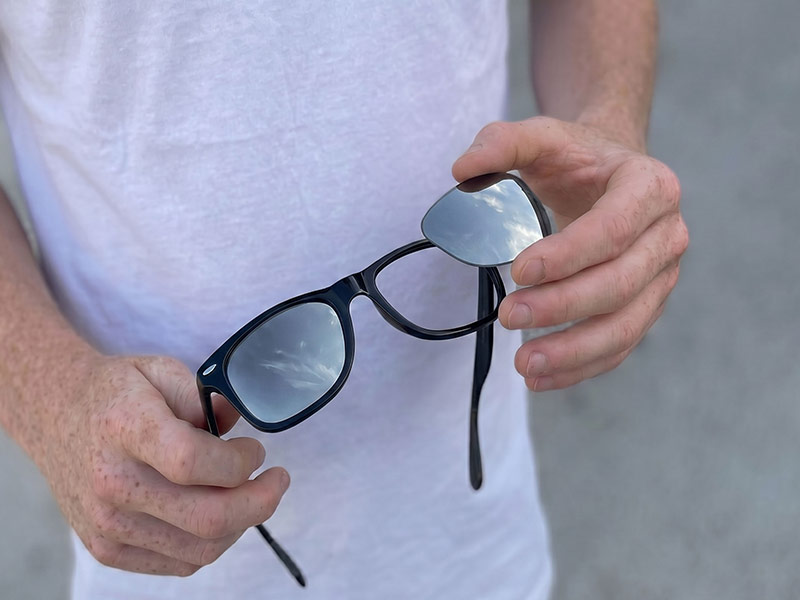
Regardless of tint color or lens darkness, a quality sunglass lens should always provide full UV protection.
A proper UV400 lens blocks harmful ultraviolet light up to 400 nanometres, helping protect your eyes from long-term sun exposure.
One of the biggest misconceptions in eyewear is that darker lenses automatically offer better protection. In reality, lens darkness and UV filtering are completely separate things.
A good sunglass lens should provide:
Our guide to UV protection sunglasses explains this topic in greater detail.
Polarization should improve comfort without compromising clarity
Polarized lenses are designed to reduce glare caused by reflected horizontal light from surfaces such as roads, water, snow, and glass.
When done properly, polarization can dramatically improve visual comfort in bright conditions and reduce eye strain during long outdoor sessions.
However, not all polarized lenses perform equally. Poor-quality polarization films or incorrect alignment can introduce unwanted color inconsistency or visual distortion.
Polarization is also not automatically the best option for every activity. Some users prefer non-polarized lenses for situations where visibility of LCD screens, such as phones, bike computers, GPS units, or car dashboards, is important.
The key part is understanding that polarization is one component of lens quality, not the only indicator of it.
For a more detailed explanation of how polarization works and when polarized lenses are useful, our guide to what polarized lenses are explores the topic in greater detail.
A quality sunglass lens is about far more than color or darkness.
The best lenses combine:
At The Sunglass Fix, these are the same factors we focus on every day when producing replacement lenses for thousands of sunglass models around the world.
Because a replacement lens should do more than simply fill the frame — it should restore the clarity, comfort, and performance that made the sunglasses worth keeping in the first place.
A quality sunglass lens should combine UV400 protection, clear optics, durable coatings, effective glare reduction, comfortable weight, and a precise fit inside the frame.
No. Lens darkness and UV protection are separate features. A dark lens does not automatically block harmful UV rays unless it includes proper UV400 protection.
No. UV protection blocks ultraviolet radiation, while polarization reduces reflected glare from surfaces such as roads, water, and snow. A lens can include both features at the same time.
There is no single “best” material for every situation. Lens performance depends on the balance between clarity, durability, weight, coatings, impact resistance, and fit precision.
Yes. High-quality replacement lenses can match or even improve the original experience when they are produced with quality materials, durable coatings, and frame-specific precision fitting.